
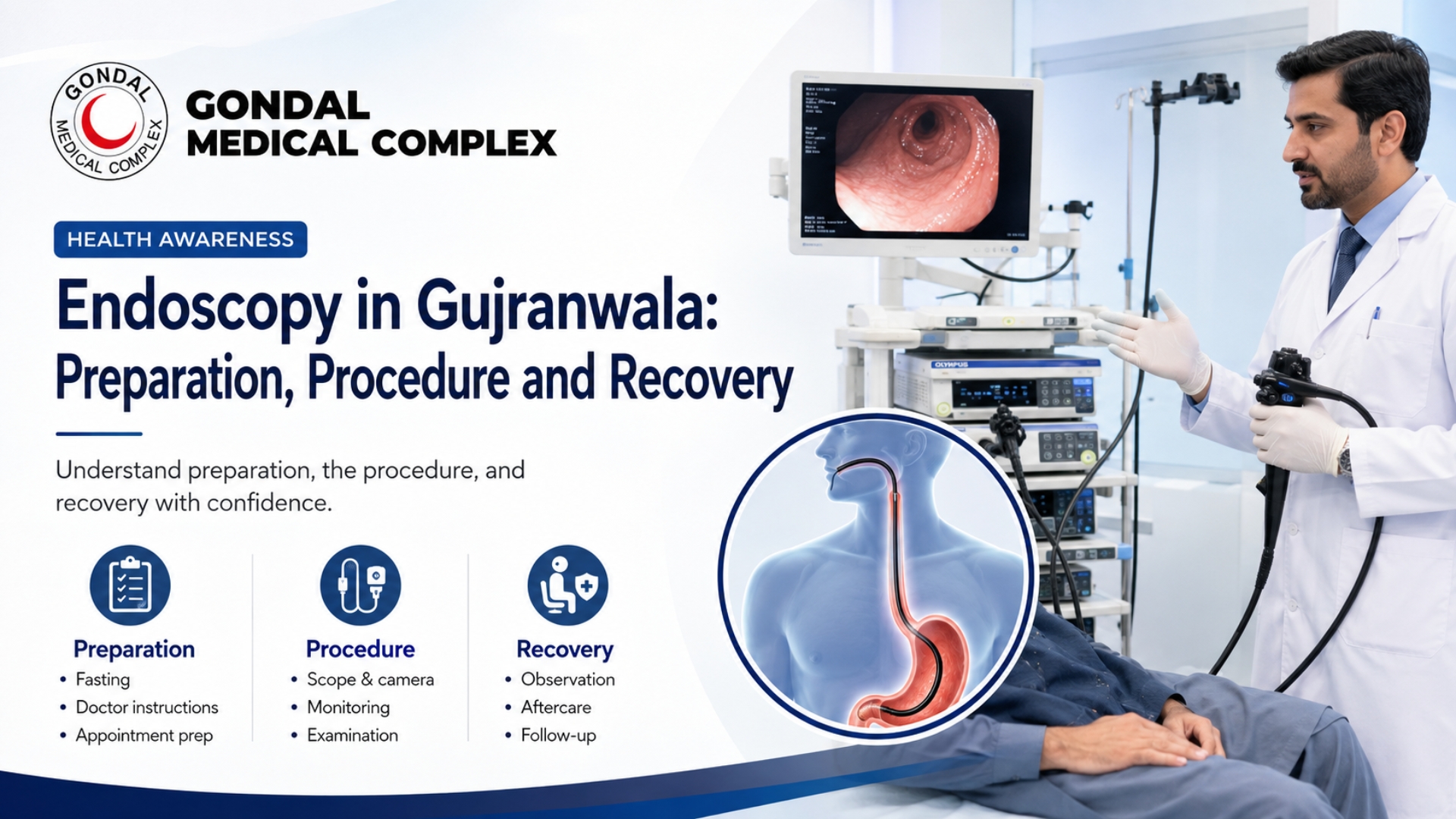
Endoscopy in Gujranwala: Preparation, Procedure and Recovery
Persistent stomach pain, difficulty swallowing, repeated vomiting, unexplained digestive bleeding or long-term acidity may require more than medicines and routine blood tests. In these situations, a doctor may recommend an upper gastrointestinal endoscopy to examine the oesophagus, stomach and the beginning of the small intestine directly.
Patients looking for endoscopy in Gujranwala often have questions about fasting, pain, sedation, biopsy and recovery. An endoscopy is generally a short procedure, but proper preparation is essential for safety and accurate results. Patients must follow their hospital’s instructions carefully, especially regarding food, water, medicines and transportation after sedation.
Gondal Medical Complex lists Endoscopy & Colonoscopy among its medical services for patients in Gujranwala. The hospital is located on Hospital Road, near Munir Chowk, Civil Lines, Gujranwala. Patients should contact the facility before visiting to confirm appointments, preparation requirements and service availability.
Medical disclaimer: This article provides general patient education. Your preparation, medicine adjustments, sedation plan and recovery instructions must come from your treating doctor and endoscopy team.
What Is an Endoscopy?
An endoscopy is a procedure in which a doctor uses a thin, flexible tube with a light and camera to look inside the body.
In digestive healthcare, the word “endoscopy” often refers to an upper gastrointestinal endoscopy, also known as:
- Upper GI endoscopy
- Gastroscopy
- Oesophagogastroduodenoscopy
- EGD or OGD
- Stomach endoscopy
During an upper GI endoscopy, the scope passes through the mouth and allows the doctor to examine the lining of the:
- Oesophagus, or food pipe
- Stomach
- Duodenum, which is the first part of the small intestine
The procedure may be used for diagnosis, tissue sampling and selected treatments, such as controlling bleeding or widening a narrowed part of the oesophagus.
Is Endoscopy the Same as Colonoscopy?
No. Both procedures use a flexible camera, but they examine different parts of the digestive system.
| Procedure | Area examined | How the scope enters |
|---|---|---|
| Upper GI endoscopy | Oesophagus, stomach and duodenum | Through the mouth |
| Colonoscopy | Large intestine and rectum | Through the anus |
Preparation is also different. Upper endoscopy mainly requires fasting so the stomach is empty. Colonoscopy usually requires a special diet and bowel-cleansing medicine.
Patients should confirm which procedure their doctor has prescribed before following preparation instructions.
Why Is an Upper Endoscopy Performed?
A doctor may recommend upper endoscopy when symptoms continue despite initial treatment or when a direct examination is needed.
Common reasons include:
- Persistent upper abdominal pain
- Frequent or severe heartburn
- Acid reflux that is not improving
- Difficulty or pain when swallowing
- Repeated nausea or vomiting
- Vomiting blood
- Black or tar-like stool
- Unexplained iron-deficiency anaemia
- Unexplained weight loss
- Suspected stomach or duodenal ulcer
- Suspected inflammation of the stomach
- Abnormal findings on another test
- A swallowed object
- Follow-up of a known digestive condition
Upper endoscopy may help identify conditions affecting the oesophagus, stomach and duodenum, including ulcers, reflux-related damage, coeliac disease, Barrett’s oesophagus, narrowing, abnormal growths and selected cancers.
What Can an Endoscopy Detect?
An upper endoscopy can allow the doctor to see:
- Inflammation of the oesophagus
- Damage caused by acid reflux
- Gastritis
- Stomach or duodenal ulcers
- Active or recent bleeding
- Narrowing of the oesophagus
- Enlarged veins in the oesophagus or stomach
- Polyps and other abnormal growths
- A hiatus hernia
- Suspicious tissue changes
- A foreign object
- Selected infections or digestive diseases
Some abnormalities can be seen immediately. Others require a biopsy and laboratory analysis before a diagnosis can be confirmed.
Can Endoscopy Treat a Problem?
Endoscopy is not only a diagnostic procedure. Depending on the condition and available facilities, the doctor may also use it to:
- Control bleeding
- Remove selected polyps or growths
- Remove a foreign object
- Take tissue samples
- Widen a narrowed oesophagus
- Apply treatment to an ulcer
- Perform another planned endoscopic intervention
The exact procedure depends on the patient’s condition and the endoscopist’s assessment.
How to Prepare for Endoscopy in Gujranwala
Preparation instructions can vary according to the procedure time, sedation method, medical history and hospital protocol. The instructions provided by the endoscopy unit should always take priority over general online guidance.
1. Confirm Your Appointment Instructions
Before the procedure, confirm:
- The appointment date and reporting time
- How long you must fast
- Whether small sips of water are allowed
- Which medicines you may take
- Whether sedation is planned
- Whether you need someone to accompany you
- Which reports and identification documents to bring
- Whether any blood tests are required
Contact the hospital if any part of the preparation is unclear.
2. Follow the Fasting Instructions
The stomach must be empty so the doctor can see its lining clearly and reduce the risk of food or liquid entering the airway.
Patients are commonly instructed not to eat for at least six hours before gastroscopy. Some patients may be asked not to eat or drink for up to eight hours, depending on the hospital’s instructions and individual circumstances. Small sips of water may sometimes be permitted until a specified time, but this must be confirmed with the endoscopy team.
Do not assume that tea with milk, juice or another drink counts as water. Follow the exact instructions given by the facility.
3. Discuss All Medicines in Advance
Tell your doctor about every medicine and supplement you take, especially:
- Aspirin
- Warfarin
- Clopidogrel
- Apixaban, rivaroxaban or other blood thinners
- Insulin
- Diabetes tablets
- Blood-pressure medicines
- Iron supplements
- Ibuprofen, naproxen or other anti-inflammatory medicines
- Herbal medicines
- Weight-management medicines
Some medicines may need adjustment before the procedure, particularly when a biopsy or treatment is planned. However, patients should not stop blood thinners, insulin or other prescribed medicines without direct medical instructions.
4. Tell the Doctor About Your Medical History
Inform the healthcare team if you have:
- Diabetes
- Heart disease
- Lung disease
- Kidney or liver disease
- A bleeding disorder
- Sleep apnoea
- Medicine or anaesthetic allergies
- A previous reaction to sedation
- Pregnancy or possible pregnancy
- Loose teeth, dentures or dental work
- A pacemaker or implanted medical device
- A history of difficult breathing during procedures
This information helps the team plan safe monitoring, sedation and aftercare.
5. Arrange Transportation
When sedation is used, the patient must arrange for a responsible adult to collect them and take them home. Sedative effects can remain for many hours, making driving and other activities unsafe.
Do not plan to drive yourself home after sedated endoscopy.
6. Bring Relevant Medical Records
Bring documents such as:
- Doctor’s referral or prescription
- Previous endoscopy report
- Previous biopsy results
- Recent laboratory tests
- Ultrasound or CT reports
- Current medicine list
- Allergy information
- Relevant hospital records
Previous results can help the doctor compare changes and understand why the test has been requested.
What Happens Before the Procedure?
After arriving at the endoscopy department, the patient may be asked to:
- Confirm personal and medical details
- Review the consent form
- Discuss symptoms and medicines
- Remove dentures or removable dental plates
- Change into a hospital gown if required
- Have blood pressure, pulse and oxygen checked
- Receive an intravenous line if sedation is planned
The medical team should explain the procedure, expected benefits, possible risks and available sedation options before consent is obtained.
Patients should use this opportunity to ask about:
- Whether a biopsy is likely
- Whether sedation will be used
- How long recovery may take
- When results will be available
- When normal food and medicines can be resumed
Is Sedation Always Required?
Not every upper endoscopy requires intravenous sedation.
Depending on the patient, procedure and hospital protocol, options may include:
- Throat-numbing spray
- Intravenous sedation
- Both throat spray and sedation
- Deeper anaesthesia for selected procedures or patients
Throat spray reduces gagging and discomfort. Sedation helps the patient feel relaxed and sleepy, although it may not always produce complete unconsciousness.
Patients should discuss previous sedation reactions, breathing problems and severe anxiety with the medical team before the procedure. NIDDK notes that many patients receive a sedative, while some procedures may be performed without one.
What Happens During an Upper Endoscopy?
The procedure generally follows these steps:
Step 1: Positioning
The patient is usually asked to lie on their side on the examination table.
Step 2: Monitoring
The team may monitor:
- Oxygen level
- Pulse
- Blood pressure
- Breathing
Step 3: Mouth Guard
A mouth guard may be placed between the teeth to protect the endoscope and the patient’s mouth.
Step 4: Scope Insertion
The doctor carefully passes the flexible endoscope through the mouth, down the oesophagus and into the stomach and duodenum.
The scope enters the digestive tract rather than the airway, so it does not normally prevent the patient from breathing.
Step 5: Internal Examination
The camera sends images to a monitor. A small amount of air or carbon dioxide may be introduced to improve visibility, which can cause temporary fullness or bloating afterward.
Step 6: Biopsy or Treatment
The doctor may pass small instruments through the scope to:
- Take tissue samples
- Control bleeding
- Remove selected growths
- Perform another necessary treatment
Patients generally do not feel a biopsy being taken from the internal lining.
Step 7: Scope Removal
After the examination is complete, the scope is removed carefully and the patient is transferred to a recovery area.
How Long Does Endoscopy Take?
A straightforward diagnostic upper endoscopy commonly takes approximately 10 to 20 minutes. It may take longer when a biopsy, bleeding treatment, dilation or another intervention is required.
The complete hospital visit is longer because it includes:
- Registration
- Pre-procedure assessment
- Preparation
- The procedure
- Sedation recovery
- Discharge instructions
Patients should avoid planning another important activity immediately after the appointment.
Is Endoscopy Painful?
Most patients experience pressure, gagging, bloating or temporary discomfort rather than severe pain.
Throat spray and sedation can make the procedure more comfortable. Some patients remember very little afterward because of the sedative.
The scope does not normally interfere with breathing. Patients may feel a mild sore throat or fullness in the stomach after the examination, but these symptoms usually improve within a short period.
Tell the medical team immediately if you experience significant pain or breathing difficulty during the procedure.
What Is an Endoscopy Biopsy?
A biopsy is a small sample of tissue taken from the lining of the digestive tract. It may be collected even when the tissue does not appear severely abnormal.
A biopsy can help investigate:
- Inflammation
- Coeliac disease
- Infection
- Barrett’s oesophagus
- Precancerous changes
- A suspicious growth
- Cancer
Taking a biopsy does not automatically mean cancer is suspected. Tissue samples are commonly used to confirm or exclude several digestive conditions.
Some visual findings can be explained soon after the endoscopy. Biopsy results require examination by a pathology laboratory and therefore take longer. The exact reporting time varies by hospital and the type of analysis required.
Recovery After Endoscopy
After the procedure, the patient is usually monitored while the sedative wears off. NIDDK notes that many patients remain in the hospital or outpatient centre for approximately an hour, although recovery time varies.
Temporary symptoms may include:
- Sleepiness
- Mild nausea
- Sore or scratchy throat
- Bloating
- Burping
- Mild abdominal discomfort
These symptoms often improve without treatment.
When Can You Eat After Endoscopy?
Do not eat or drink until the throat numbness has worn off and you can swallow normally.
One NHS hospital advises waiting around 30 to 45 minutes after gastroscopy before eating or drinking, although the exact timing should come from the endoscopy team.
When permitted, begin with:
- Small sips of water
- A light meal
- Soft foods
- Foods recommended by the doctor
The doctor may provide a special diet when an ulcer, narrowing, bleeding problem or another condition was treated.
Activities to Avoid After Sedation
For approximately 24 hours after sedation, patients are commonly advised not to:
- Drive a car or motorcycle
- Ride a bicycle
- Operate machinery
- Drink alcohol
- Take sleeping tablets unless instructed
- Sign legal documents
- Make major financial decisions
- Return to demanding work
- Care for children alone
- Perform activities requiring coordination or judgment
A responsible adult should collect the patient and may need to stay with them during the recovery period.
Follow the specific discharge instructions provided by your endoscopy unit.
When Can You Return to Work?
Patients who receive sedation may need the rest of the day off and, depending on their work, may need the following day for recovery.
A person whose job involves:
- Driving
- Heavy machinery
- Heights
- Physical labour
- Important decision-making
- Responsibility for public safety
should not return until the sedative restrictions have ended and they feel fully recovered.
Patients who only receive throat spray may recover sooner, but the healthcare team’s advice should still be followed.
Risks of Upper GI Endoscopy
Upper endoscopy is generally considered a low-risk procedure, but no medical procedure is completely risk-free.
Possible complications include:
- Reaction to sedation
- Breathing or heart problems related to sedation
- Bleeding
- A tear or perforation in the digestive tract
- Aspiration of stomach contents
- Infection in selected situations
- Dental or throat injury
Bleeding is often minor, particularly after a small biopsy. Serious complications such as perforation are uncommon but may require urgent treatment or surgery.
The risk may be greater when:
- A treatment is performed
- A large growth is removed
- The patient has major medical conditions
- Blood-thinning medicine is being used
- The patient has a bleeding disorder
- Emergency endoscopy is required
The doctor should explain risks relevant to the planned procedure.
Warning Signs After Endoscopy
Seek urgent medical care after upper endoscopy if you develop:
- Difficulty breathing
- Increasing difficulty swallowing
- Severe or worsening throat pain
- Severe or worsening chest pain
- Severe or persistent abdominal pain
- Repeated vomiting
- Vomiting blood
- Vomit that resembles coffee grounds
- Black, tar-like stool
- A large amount of fresh blood
- Fever
- Fainting, severe dizziness or weakness
These symptoms can indicate bleeding, perforation, infection or another complication and should not be ignored.
Take your endoscopy report and discharge instructions when seeking emergency treatment.
How to Choose an Endoscopy Facility in Gujranwala
When selecting a facility for endoscopy in Gujranwala, consider:
- Availability of an experienced medical team
- Pre-procedure assessment
- Proper patient monitoring
- Clear fasting and medicine instructions
- Sedation support
- Infection-control practices
- Access to biopsy and pathology services
- Emergency support
- Written recovery instructions
- A clear process for receiving results
Patients should also confirm whether the planned procedure is diagnostic or therapeutic and whether additional charges may apply for sedation, biopsy, pathology or treatment.
Gondal Medical Complex identifies Endoscopy & Colonoscopy among its hospital services and provides emergency, specialist and diagnostic support for Gujranwala and surrounding communities.
Questions to Ask Before Booking an Endoscopy
Before confirming the appointment, ask:
- Which type of endoscopy has been prescribed?
- Who will perform the procedure?
- Will sedation be used?
- How long should I fast?
- Can I drink water?
- Which morning medicines should I take?
- What should I do with insulin or diabetes tablets?
- Should blood thinners be stopped or adjusted?
- Can a biopsy be performed if needed?
- When will the report be available?
- How long will I remain at the hospital?
- Do I need an attendant?
- What symptoms require emergency contact?
Clear answers can reduce anxiety and prevent preparation errors.
Frequently Asked Questions
What is the cost of endoscopy in Gujranwala?
The cost can vary according to the hospital, doctor, type of endoscopy, sedation, biopsy, pathology testing and whether treatment is performed. Contact the chosen facility directly for an updated estimate.
How many hours of fasting are required before endoscopy?
Patients are commonly asked not to eat for at least six hours. Some may need to avoid food and drinks for up to eight hours. Follow the exact written instructions from the endoscopy unit.
Can I drink water before an endoscopy?
Small sips of water may sometimes be permitted until a specific time, but this varies by hospital and patient. Do not drink water unless your appointment instructions allow it.
Is endoscopy painful?
Most patients experience temporary discomfort, pressure, gagging or bloating rather than severe pain. Throat spray and sedation can improve comfort.
Can I breathe during an endoscopy?
Yes. The endoscope passes through the oesophagus rather than the airway and does not normally interfere with breathing.
How long does an endoscopy take?
A standard diagnostic upper endoscopy commonly takes around 10 to 20 minutes. Biopsy or treatment can make the procedure longer.
Can I go home immediately after endoscopy?
Patients who receive sedation need monitoring until they are sufficiently awake and stable. Many remain in recovery for approximately an hour, but the duration varies.
Can I drive after an endoscopy?
Do not drive after receiving sedation. Arrange for a responsible adult to take you home and follow the 24-hour activity restrictions provided by the healthcare team.
Is a biopsy during endoscopy painful?
Patients generally do not feel the small tissue sample being collected from the digestive lining.
Does a biopsy mean the doctor suspects cancer?
No. Biopsies are also taken to investigate inflammation, infection, coeliac disease, Barrett’s oesophagus and other non-cancerous conditions.
When will I receive my endoscopy results?
Visual findings may be discussed on the same day. Biopsy results take longer because the tissue must be examined by a pathology laboratory. The exact reporting time varies by facility.
Conclusion
Upper GI endoscopy allows a doctor to examine the oesophagus, stomach and duodenum directly. It can help investigate persistent pain, swallowing difficulty, reflux, vomiting, digestive bleeding, ulcers and other gastrointestinal conditions.
Proper preparation is essential. Patients must follow fasting instructions, discuss blood thinners and diabetes medicines, disclose relevant medical conditions and arrange transportation when sedation is planned.
The procedure itself is commonly completed within 10 to 20 minutes, but additional time is required for preparation and recovery. Mild throat irritation and bloating can occur afterward, while severe pain, breathing difficulty, vomiting blood, black stool or fever requires urgent medical attention.
Call to Action
For patients seeking endoscopy in Gujranwala, Gondal Medical Complex lists Endoscopy & Colonoscopy among its available hospital services. Visit Gondal Medical Complex to review its healthcare services or request appointment guidance.
The hospital is located on Hospital Road, near Munir Chowk, Civil Lines, Gujranwala. Patients can contact the facility through the website or call 055-325-8403 or 055-325-1056/1057 to confirm appointment availability, fasting instructions and required documents before visiting.